

Does server-side tracking improve Meta ad delivery?
Server-side tracking can improve Meta's conversion feedback. Learn when CAPI can help delivery, what it cannot fix, and how to evaluate real campaign outcomes.
measure → evaluateIn this article
Server-side tracking can improve Meta ad delivery when it supplies useful conversion events that were missing, incomplete, or arriving too late. The benefit comes from better feedback about the outcomes you want. Connecting an API does not, by itself, prove that acquisition became more efficient.
For a media buyer, there are two results to evaluate: whether the conversion flow became more complete, and whether the campaign generated better business outcomes. Keeping those questions separate makes the improvement easier to identify and explain.
How does server-side tracking affect Meta's feedback?
Meta's Conversions API provides a server-side route for conversion events. In a Skro setup, a supported incoming conversion can be linked to its tracked interaction and sent through the configured Meta integration. This can report an outcome received from a network or backend without requiring the visitor's browser to send that conversion request at the same moment.
The useful chain is:
- A real action occurs, such as an approved lead or completed purchase.
- Your source system reports it with the references and values the integration needs.
- Skro records the outcome and maps it to the intended Meta event.
- You verify receipt and the available diagnostics in Meta.
- You evaluate whether the campaign's selected optimization outcome reflects the business result you want.
That last step matters. If your business earns revenue from approved leads, receiving more registration events is not enough to show that the feedback is useful for that goal. Decide which stage should inform the campaign, then configure and validate that event deliberately.
When is CAPI most likely to help?
The strongest reason to investigate is a known gap between real outcomes and the conversion events reaching the intended Meta pixel or dataset. Start with evidence from your own flow rather than an assumed recovery percentage.
| Situation | What to investigate | What a useful improvement looks like |
|---|---|---|
| The source records an outcome but the browser event is missing | Whether a supported backend or postback can report the event. | More eligible real outcomes reach the configured destination. |
| The first event is a signup, but qualification happens later | How the later outcome is recorded and mapped. | The relevant business stage is available as a correctly configured event. |
| Events arrive with inconsistent values | Currency, payout, event definitions, and occurrence time. | Comparable events describe comparable outcomes. |
| Browser and server both report one purchase | Matching event names and identifiers. | Corresponding copies are recognized as the same action. |
These are implementation opportunities, not promises of a particular change in CPA or ROAS. Their value depends on the original gap and on whether your campaign can use the resulting signal appropriately.
Check signal quality before judging ad performance
Meta's Conversions API optimization training identifies event matching, coverage, quality, deduplication, and freshness as practical areas to review. Use those diagnostics to investigate the event flow; use business records to assess the result.
For a Skro implementation, ask five questions:
- Receipt: does the intended event reach both Skro and the selected Meta destination?
- Meaning: does its name represent the actual outcome, rather than a different funnel stage?
- References: have you preserved the click reference and any supported matching information the flow genuinely supplies?
- Copies: if another sender reports the same action, can you identify the corresponding copies consistently?
- Values and timing: do the amount, currency, and occurrence time describe the source event correctly?
The additional Meta parameters guide explains supported fields in Skro, including fbp and eventId. Send genuine values from your configured collection flow. A fabricated identifier does not improve the underlying evidence, and a server connection does not remove the need to respect the data-sharing choices in your implementation.
Worked example: better leads can matter more than more leads
Consider two fictional evaluation periods for a lead-generation campaign. Suppose all leads have completed the same qualification process before the comparison is made.
| Business metric | Period A | Period B |
|---|---|---|
| Advertising cost | €1,000 | €1,000 |
| Form submissions | 100 | 80 |
| Qualified leads accepted by the business | 20 | 32 |
| Cost per form submission | €10 | €12.50 |
| Cost per qualified lead | €50 | €31.25 |
| Qualification rate | 20% | 40% |
Judged by form-submission cost, Period B looks worse. Judged by the qualified outcome, it looks better. The lesson is to choose a business outcome before deciding which conversion metric should define success.
These numbers are arithmetic examples, not a Skro case study or an expected CAPI uplift. They also do not establish what caused the difference. Changes in creative, audience, landing page, budget, qualification rules, or market conditions could affect those results.
If your server-side project makes later-stage events available, record exactly what changed in collection and event selection. Then assess the business outcome with a comparison designed to separate those changes from other campaign changes.
How should you test whether delivery improved?
Begin with a technical validation and a business evaluation plan. Those are related, but they need different evidence.
Validate the implementation first. Use a controlled source event, verify the click and event references, and check the selected destination. Resolve missing or duplicate events before treating the data as an experiment input. Our CAPI implementation article covers that verification path.
Define the outcome and denominator. For example, choose approved purchases per advertising euro or cost per accepted lead. Include the relevant approval or revenue maturity period. An increase in recorded events can reflect more complete measurement without an increase in real sales.
Plan a comparable evaluation. Use an appropriate controlled test where feasible. If you use before-and-after periods, document changes to targeting, creative, spend, funnel, and reporting settings. A simple before-and-after difference is not enough to isolate causation.
Review data after outcomes mature. Allow the source systems to finish the approvals and updates relevant to your conversion flow. Do not declare success from a higher match-quality score alone or from a reporting period that is still missing revenue.
What can server-side tracking not fix?
CAPI cannot report a purchase that the source system never recorded. It cannot supply a missing original click reference automatically, and it cannot turn an unqualified registration into a sale. It also does not repair an offer that visitors do not want or creative that fails to explain it.
Another limitation is the input event itself. Sending the wrong value more reliably can make a report more consistently wrong. Establish event ownership when several systems can send the same outcome, and test the combined setup rather than adding senders without a plan.
If the incoming conversion is absent from Skro, investigate the earlier handoffs with the tracking troubleshooting checklist. If it is present in Skro but absent from Meta, investigate the outgoing integration and destination separately.
Questions advertisers ask about server-side tracking
Will CAPI automatically lower my Facebook Ads CPA?
No fixed CPA reduction follows from enabling it. First verify that useful events reach the intended destination; then evaluate acquisition cost against mature, real business outcomes under a suitable comparison.
Does a higher Event Match Quality score prove better delivery?
It provides information about the matching data received by Meta. It is useful for diagnosing the setup, but it does not by itself establish more sales, lower business acquisition cost, or a causal delivery improvement.
Should I remove my browser pixel after connecting CAPI?
Do not change the existing sender arrangement without reviewing the complete setup. If browser and server paths report corresponding copies, configure their event identifiers consistently and verify the receiving system's deduplication result. See the Meta event-ID explanation.
Is server-side tracking the same as cookieless tracking?
Not necessarily. A conversion request can be sent server to server while an earlier collection step still uses browser storage or browser identifiers. Inspect the whole journey before describing a specific implementation as cookieless.
Does Meta automation replace the need for reliable tracking?
No. Skro's Meta automation rules evaluate the reporting inputs you configure. If cost or approved conversions are incomplete, a correctly implemented rule can still act on an incomplete picture.
Choose one outcome and verify its complete path
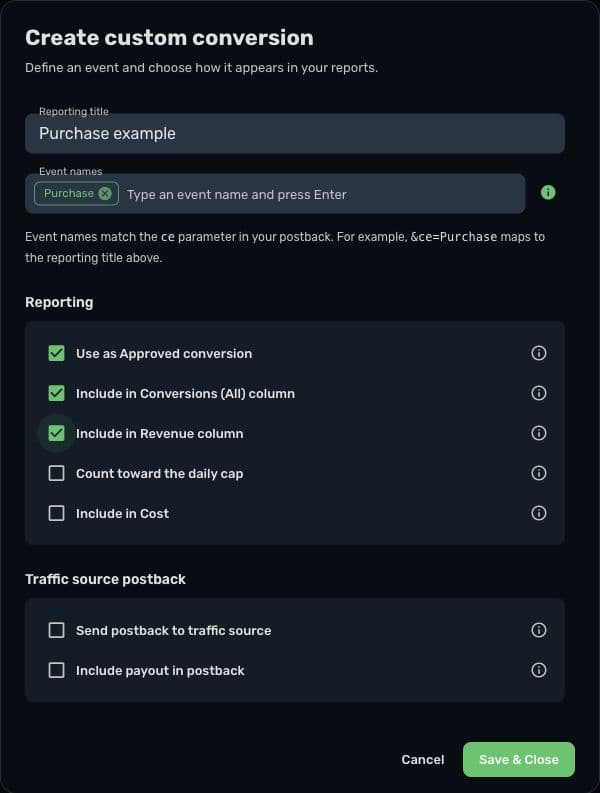
Start with the conversion stage that matters to your business. Follow the Skro Meta CAPI setup guide, confirm the corresponding custom conversion settings, and verify a controlled event in the intended destination.
If you are choosing software for that workflow, use our best ad trackers comparison. Evaluate the event flow you can demonstrate, then measure the campaign result you actually want to improve.