

Pinterest Ads integration
Connect Pinterest Ads to Skro, track conversions with Conversions API, map events and URL parameters, and manage campaigns, ad groups, budgets, and bids.
Connect Pinterest Ads to compare advertising delivery with Skro visits, conversions, revenue, and profit. Send website conversions back through Pinterest Conversions API and manage supported campaigns, ad groups, and ads from Skro.
Before you begin
- Have access to the Pinterest advertising account you want to connect and permission to authorize Skro.
- For conversion reporting, prepare a Conversions API access token for the Pinterest advertising account you connect. Pinterest explains how to generate a token in its Conversions API setup guide.
- In Skro, use an owner or manager account and prepare your tracking domain, destination website, and conversion reporting method.
Step 1. Connect your Pinterest account
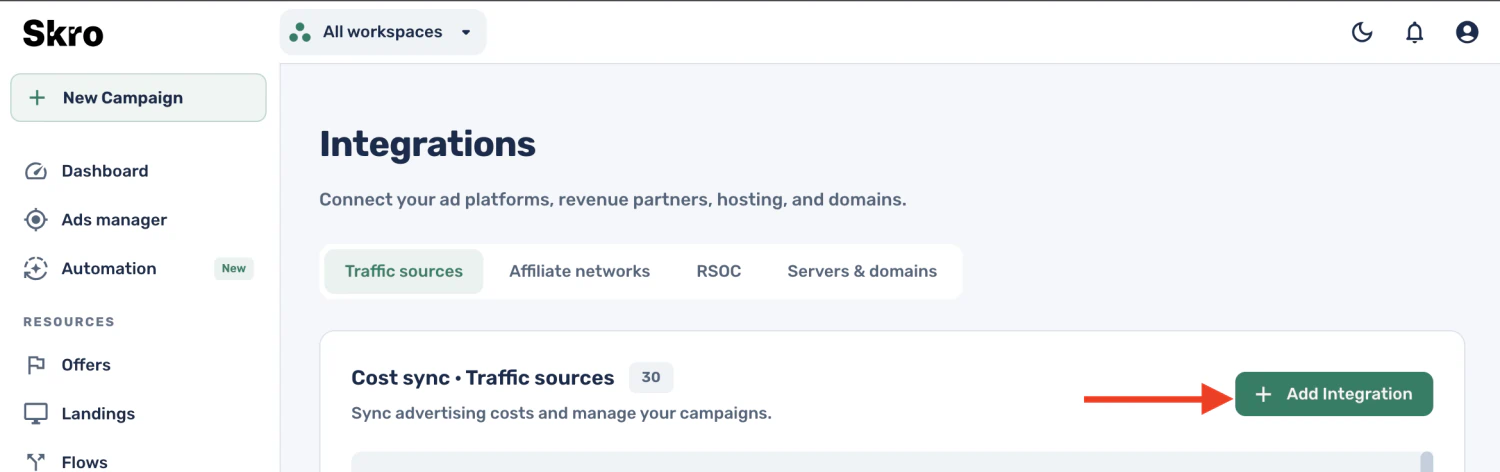
- Open Integrations → Traffic sources and select Add Integration.
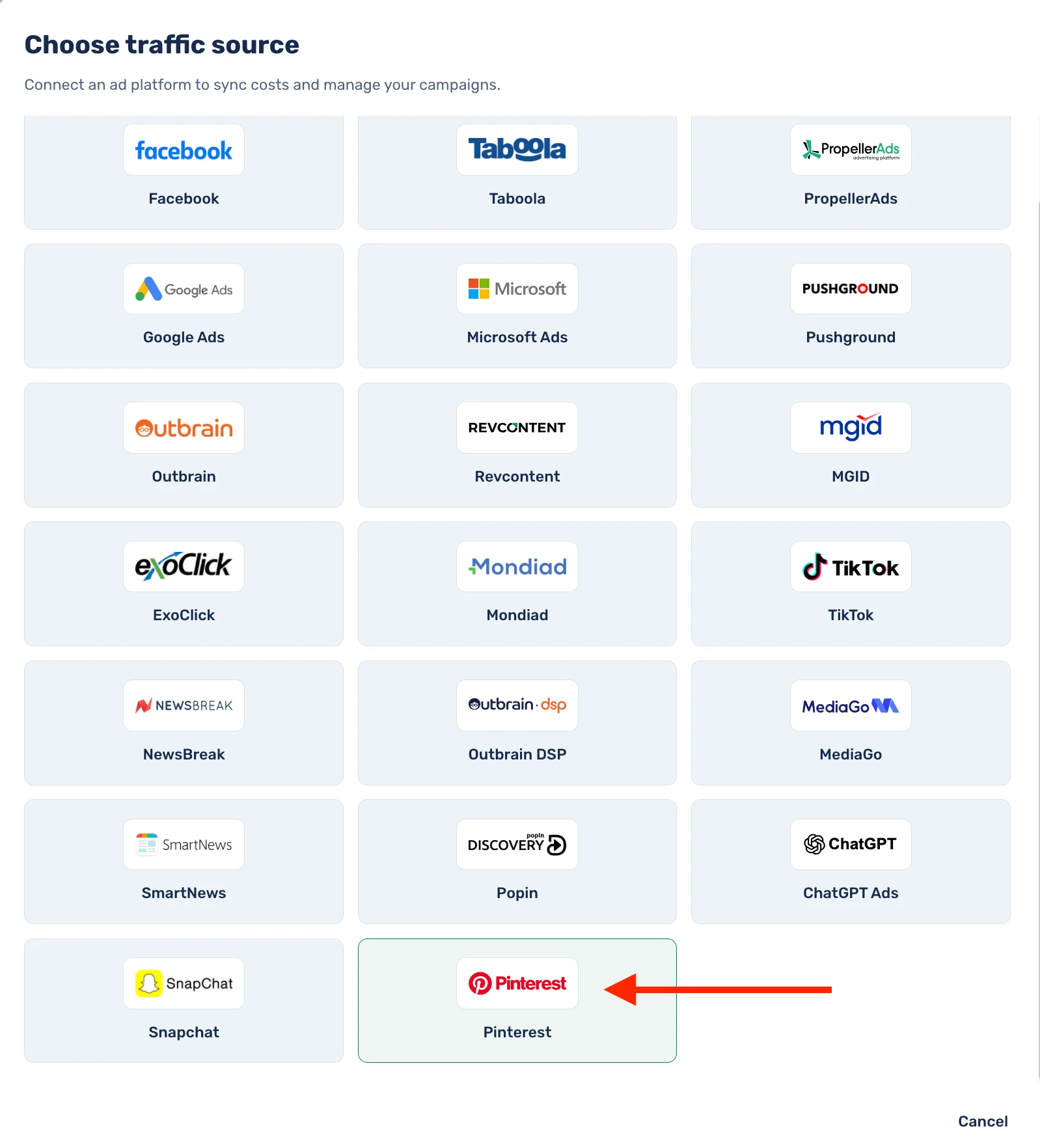
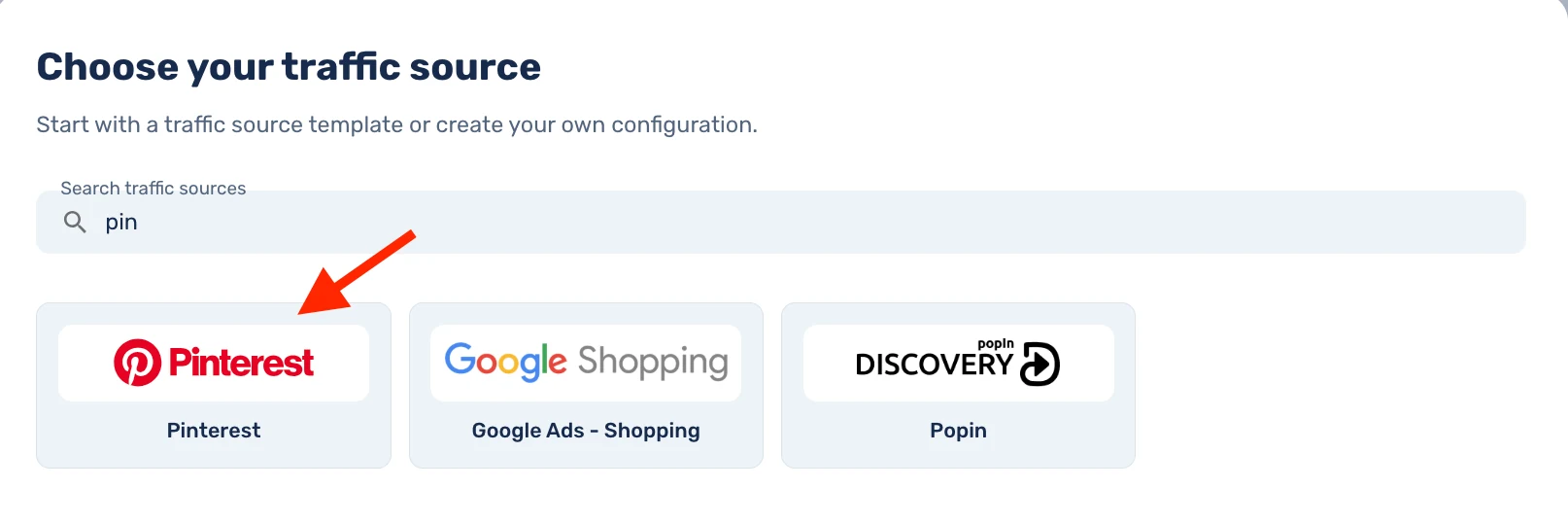
- Select Pinterest.
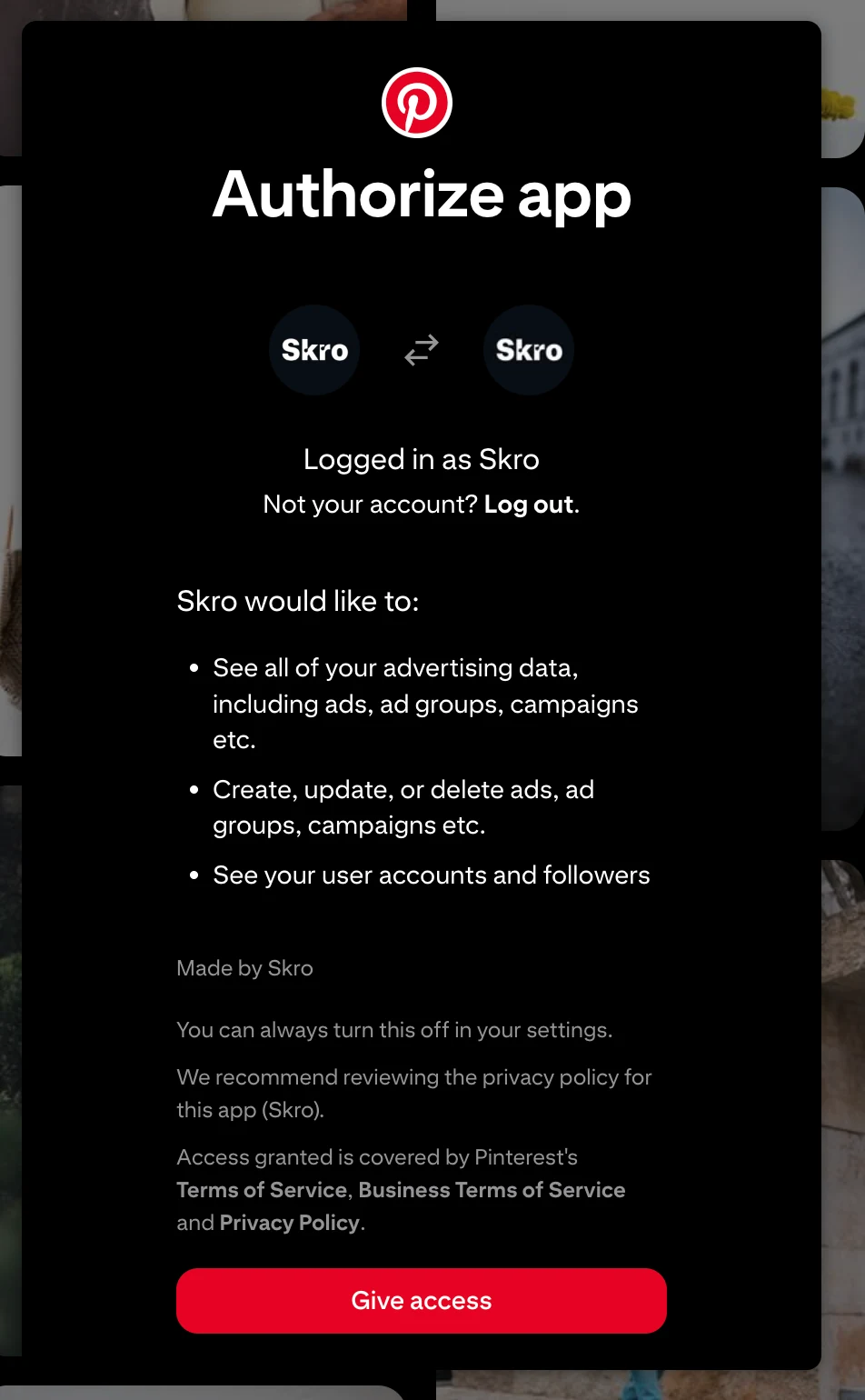
- Sign in to Pinterest and select Give access to authorize the connection, then return to Skro.
- Under Pinterest Ad Accounts, select Integrate for the account you want to use. Confirm that it shows Integrated, then select Next.
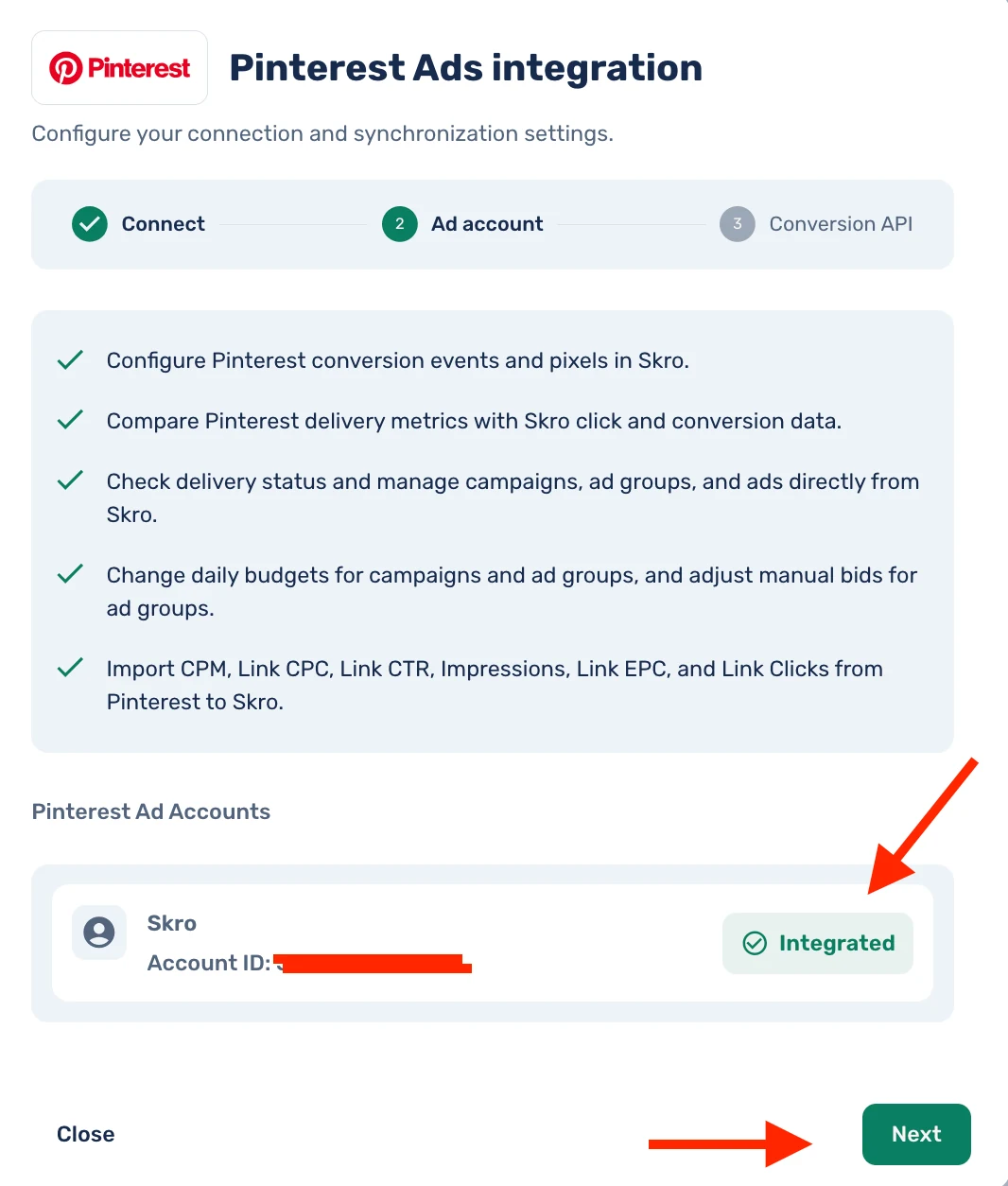
- To use reporting and campaign controls without sending conversions yet, leave Enable Conversion API off and select Save & Close. You can edit the integration later to complete Step 2.
Step 2. Configure Pinterest Conversions API
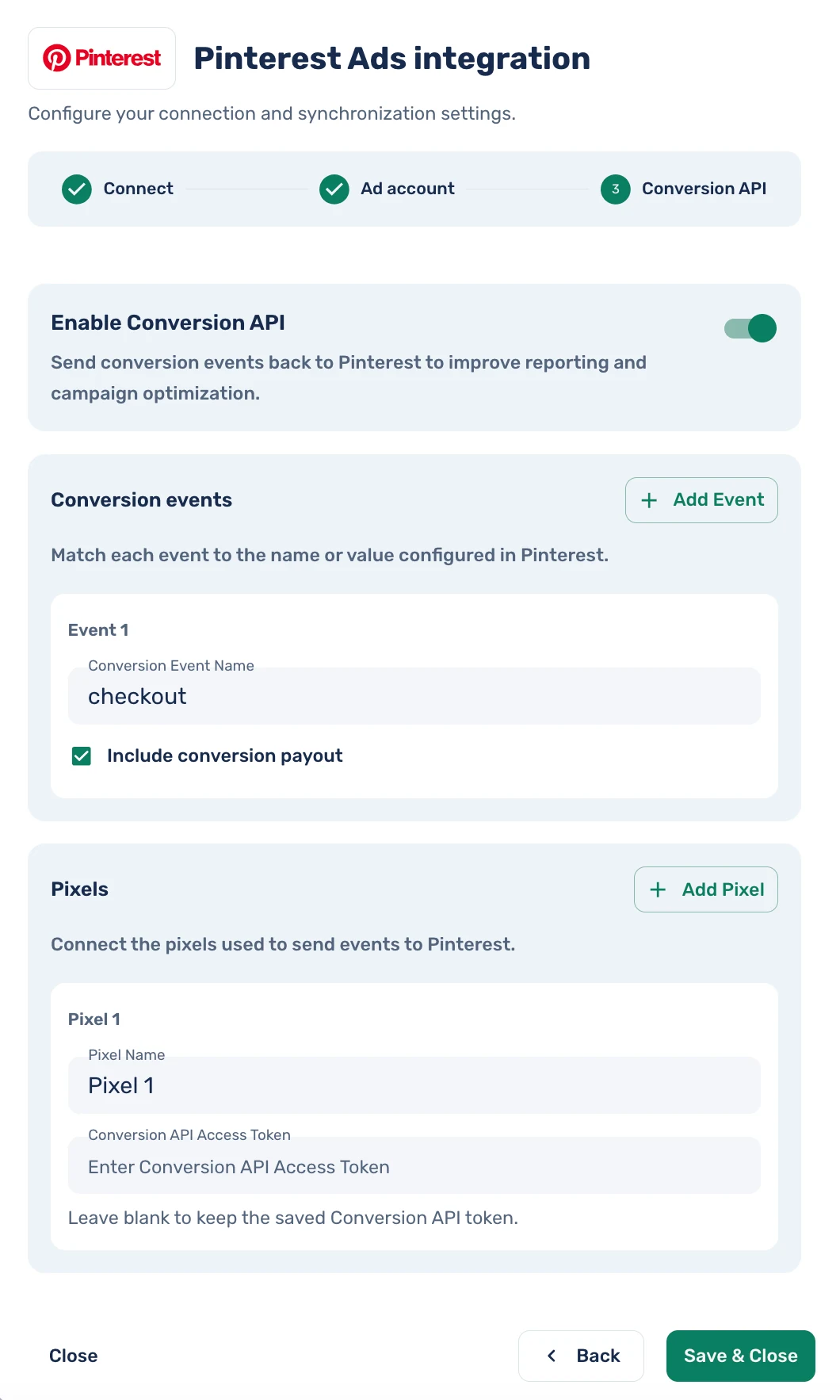
- Turn on Enable Conversion API.
- Under Conversion events, select Add Event. For completed purchases, enter
checkoutand enable Include conversion payout to forward the recorded value and currency. - Under Pixels, enter a recognizable Pixel Name and the account's Conversion API Access Token.
- To save multiple tokens, select Add Pixel for each additional token and give it a distinct Pixel Name so you can identify it when setting up a campaign.
- Select Save & Close. When editing an existing configuration, leave its access token blank to keep the saved token.
Pinterest's completed-purchase event is checkout. Use initiate_checkout when a shopper starts checkout. On your Skro campaign, select the event and pixel configuration you created here.
Skro sends conversions to the connected Pinterest ad account. Each named entry under Pixels stores a conversion token for use on your campaigns. Use a token that belongs to the account receiving the events.
Step 3. Create and link the traffic source
- Open Traffic sources → Create and select the Pinterest template.
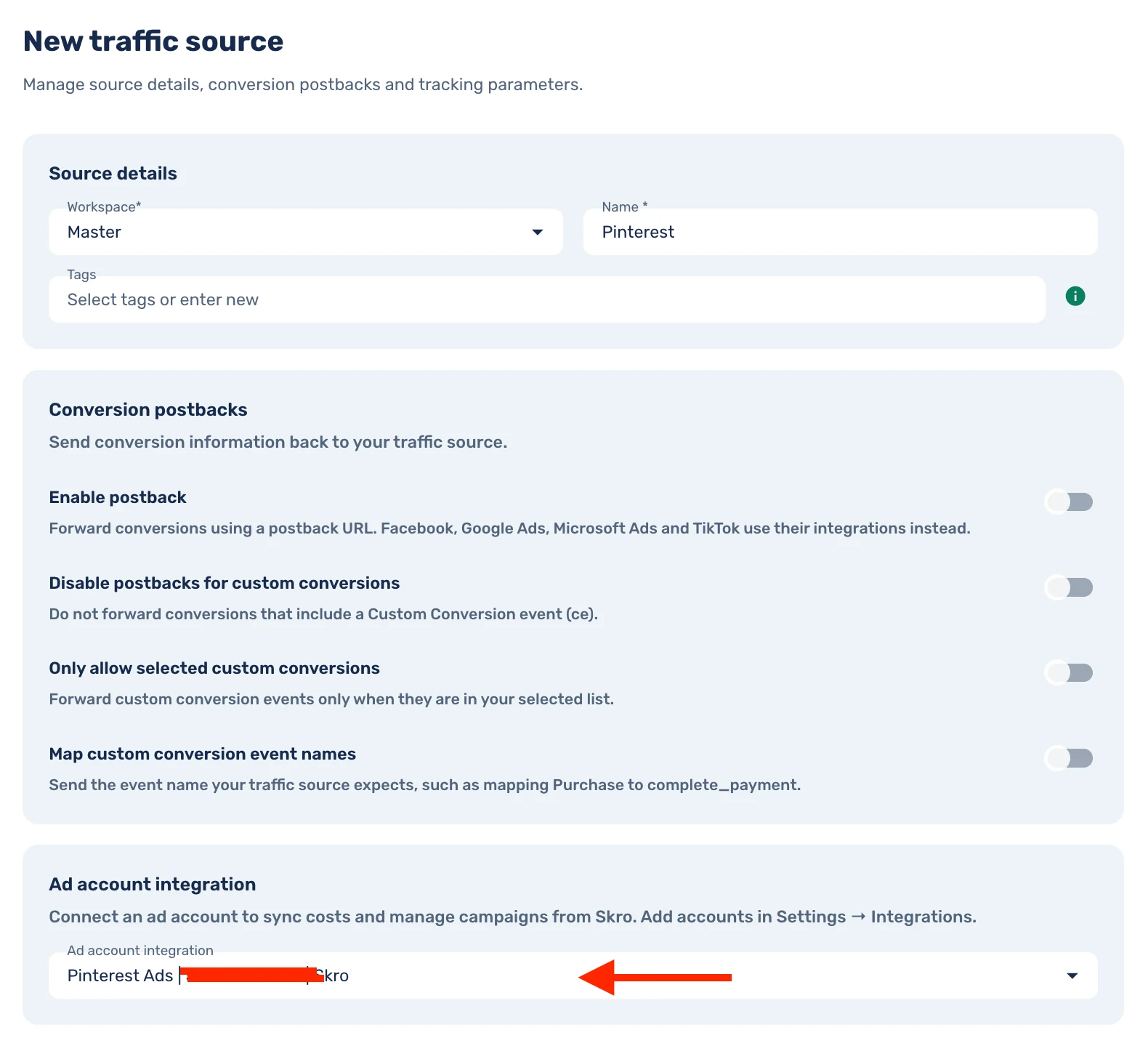
- Choose your workspace and enter a recognizable name.
- Under Ad account integration, choose the Pinterest account connected in Step 1.
- Leave the generic Enable postback switch off when using the Pinterest Conversions API integration. Review your conversion filtering and event mapping settings if you use custom conversions.
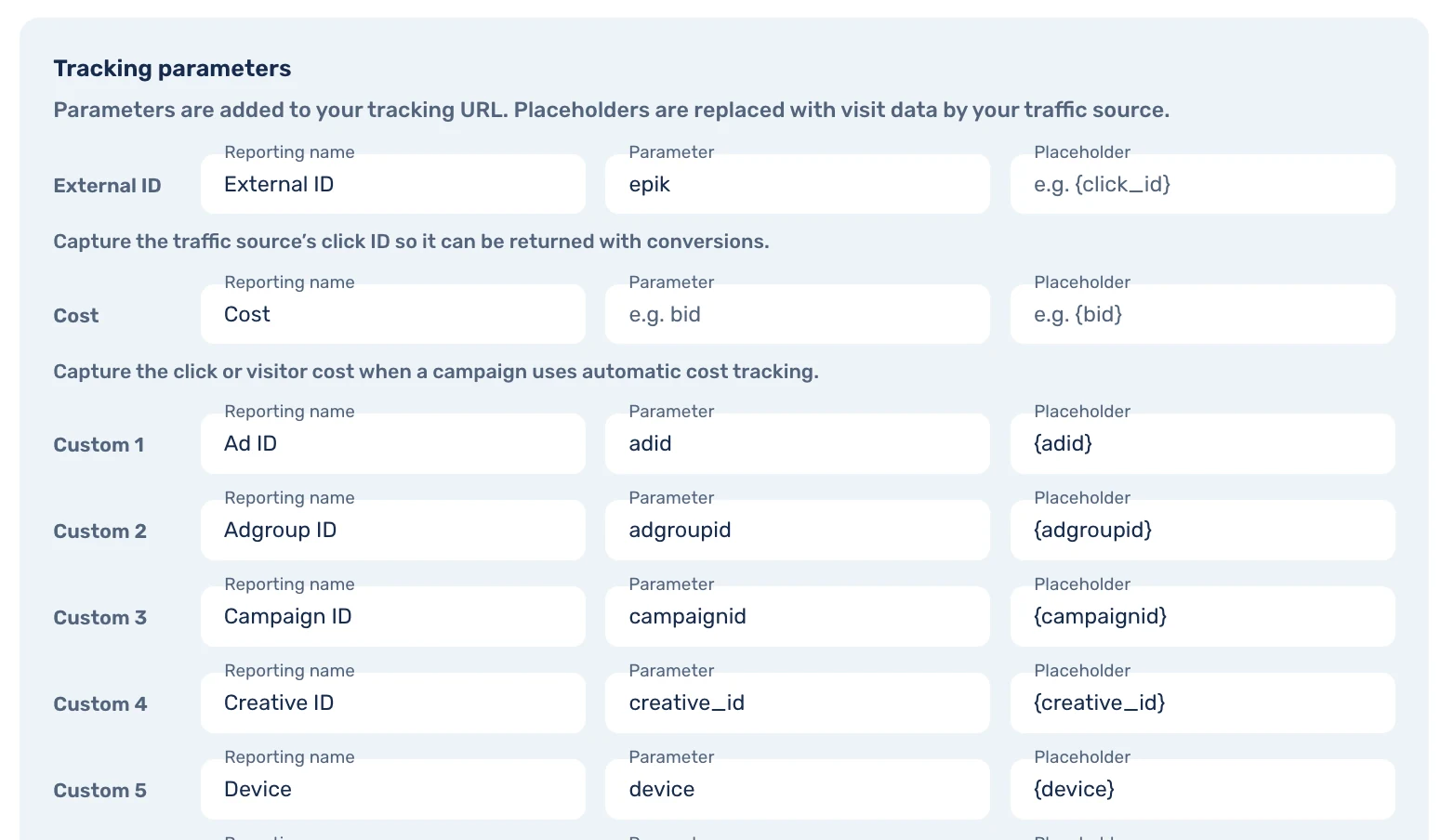
- Review the tracking parameters and select Create source.
Tracking parameter mapping
The prefilled Pinterest template uses this mapping. Preserve the parameter names and custom field positions when generating your campaign links.
| Skro field | Reporting name | URL parameter | Pinterest value |
|---|---|---|---|
| External ID | External ID | epik | Actual Pinterest click reference. Leave the placeholder blank. |
| Custom 1 | Ad ID | adid | {adid} |
| Custom 2 | Adgroup ID | adgroupid | {adgroupid} |
| Custom 3 | Campaign ID | campaignid | {campaignid} |
| Custom 4 | Creative ID | creative_id | {creative_id} |
| Custom 5 | Device | device | {device} |
The Cost parameter is blank in this template. Leave it blank unless you have a supported cost parameter to capture, and choose the appropriate cost model on your Skro campaign.
Use {adid}, {adgroupid}, and {campaignid} for the entity fields used by Skro's Pinterest campaign controls. These use single braces. Pinterest expands dynamic parameters on live ad clicks; previews leave them unresolved. Pinterest dynamic tracking parameters
adid={adid}&adgroupid={adgroupid}&campaignid={campaignid}&creative_id={creative_id}&device={device}This snippet is an example parameter string, not a complete campaign link. Copy your full URL from Campaign links, and avoid adding a parameter twice. Preserve the actual epik reference through any redirects so Skro can save it as the External ID.
Step 4. Add your landing page and offer
Create a landing page (optional)
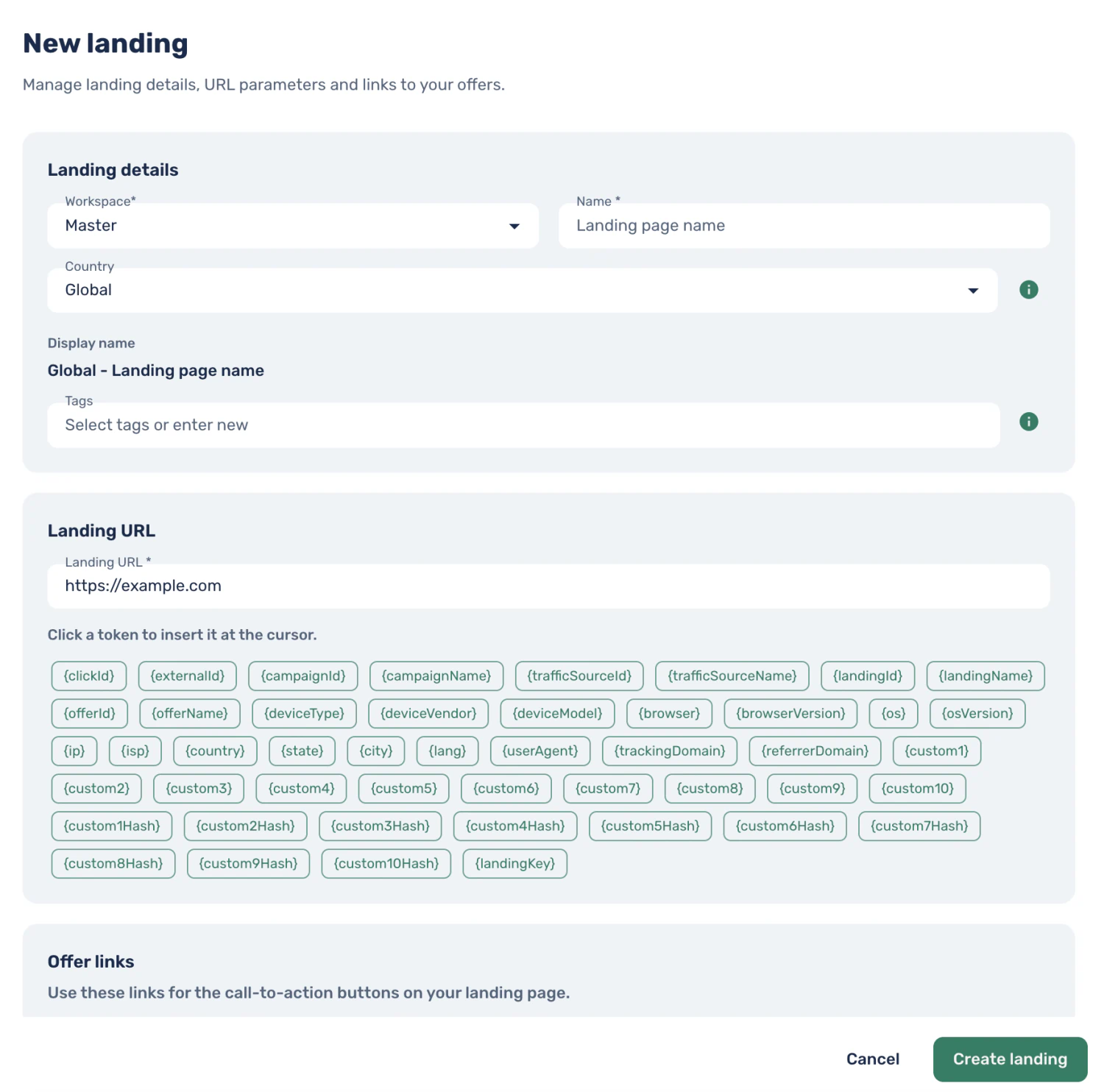
- Open Landings → Create. Choose your workspace, enter a name, and paste your page address into Landing URL.
- Copy the appropriate link under Offer links and use it for the landing page buttons that lead to your offer.
- Select Create landing. If visitors go straight to an offer or store, you can use an offer-only campaign path instead.
Create an offer
- Open Offers → Create. Choose your workspace, enter a name, and paste the destination into Offer URL.
- Pass Skro's
{clickId}token using the parameter your website or affiliate network expects. For a destination readingclickId, an example ishttps://example.com/?clickId={clickId}. - Select the affiliate network when applicable and select Create offer.
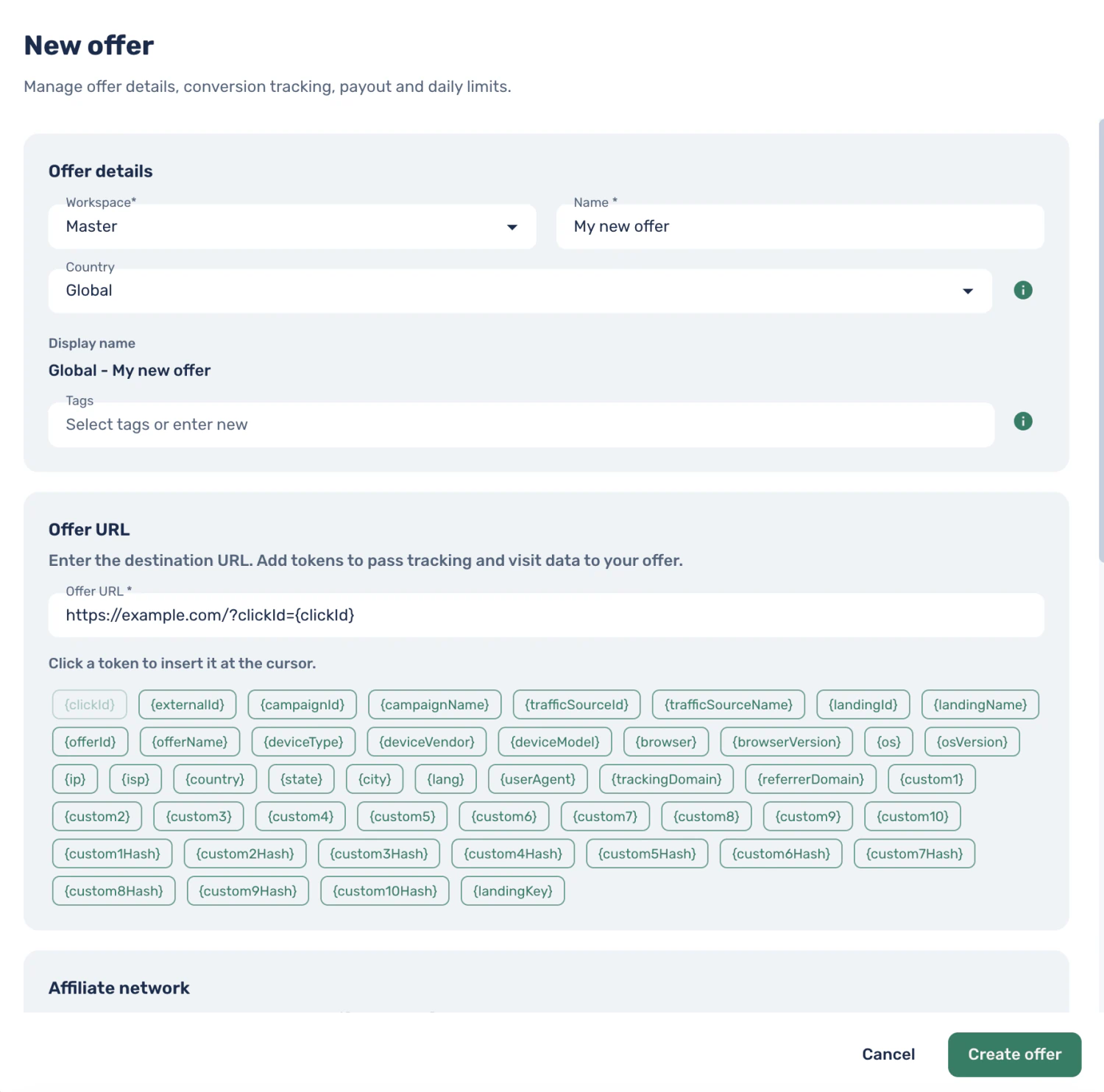
The shared screenshots show the landing and offer forms used for Pinterest as well. For a Shopify store, follow the Shopify integration guide for its specific tracking setup.
Step 5. Create the Skro campaign
- Select New Campaign or Create in Ads manager. Enter the campaign name and workspace, choose your linked Pinterest traffic source, and select a tracking domain.
- If Conversions API is enabled, choose the Conversion Event Name and Conversion Pixel. The Conversion Pixel selects the named token configuration saved in Step 2. For a completed purchase, select the
checkoutevent. - Select the appropriate Cost model. Use Automatic when costs come from an enabled cost integration or supported URL parameters, then select Continue.
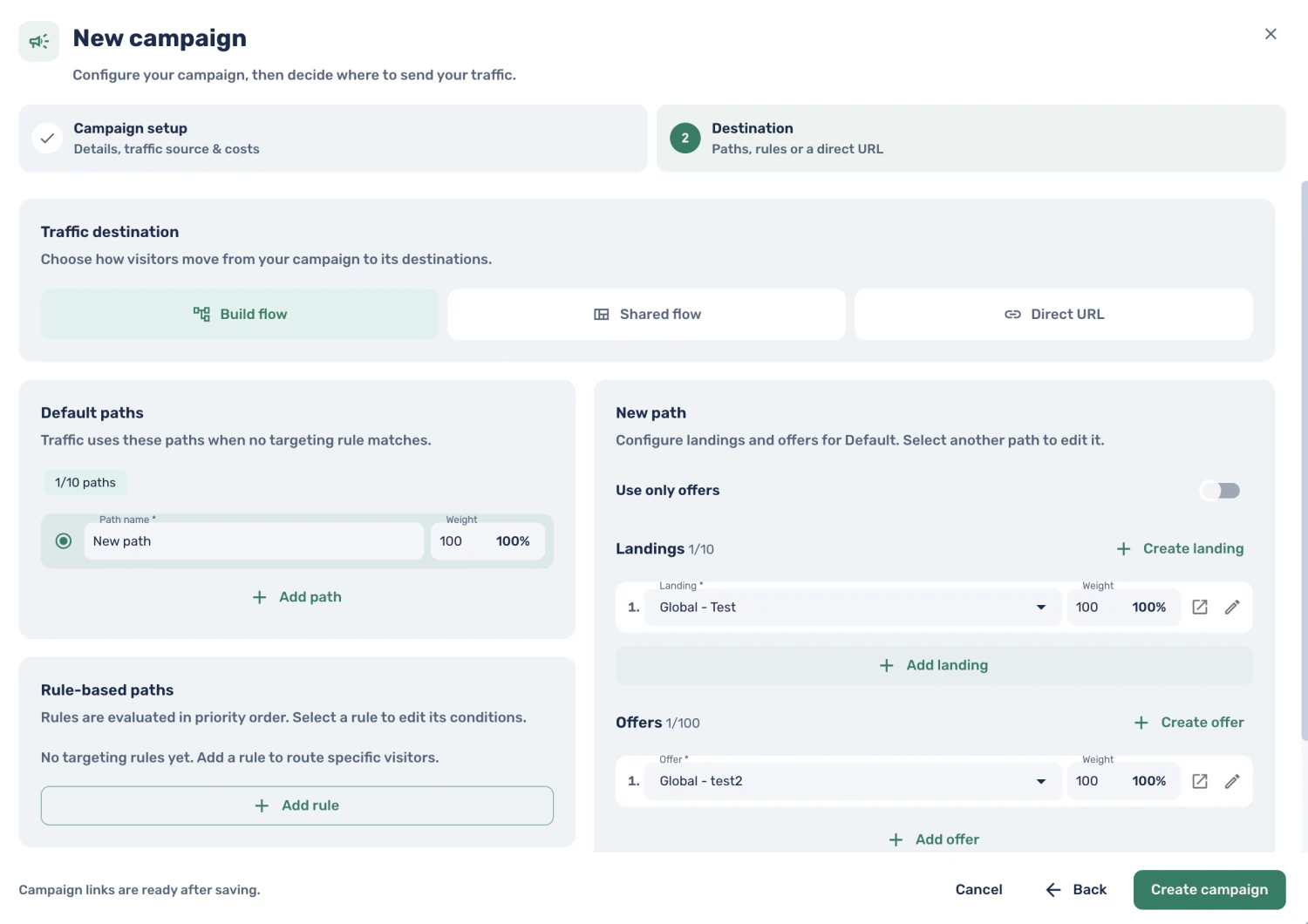
- Under Destination, choose Build flow and select your landing and offer. Turn on Use only offers for an offer-only route, then select Create campaign.
- Open Campaign links. Choose Direct to track on your own website or Redirect to send visitors through the Skro campaign URL.
- Copy the generated URL. For Direct tracking, install the generated landing or offer tracking script in that page's
<head>section. - Open Conversion tracking and configure your website or affiliate network to report conversions using the saved Skro click ID.
The Skro click ID and Pinterest's epik have different roles. Your postback uses the Skro click ID to find the visit. Skro retrieves the saved Pinterest reference from that visit when sending the conversion to Pinterest. Keep the complete generated URL, including trck for direct tracking.
Step 6. Configure your Pinterest ad
- Use the generated destination URL in your Pinterest ad, choosing the tracking method appropriate for your website and ad setup.
- Keep your entity parameter names aligned with the Skro traffic source. Review account- or campaign-level URL parameters to avoid duplicates. Pinterest URL parameter settings
- Follow a live ad click and confirm that the correct campaign, ad group, and ad IDs reach Skro, together with the actual
epikreference when present. - Complete one test conversion and follow the verification checklist below.
Standard conversion events and Skro mappings
Choose the event that describes the action your customer completed. The Skro ce values below are examples you configure; map them to the Pinterest API names on the traffic source. A mapping is especially important for purchases: Skro Purchase should map to Pinterest checkout.
Skro ce example | Pinterest API event | Action |
|---|---|---|
PageView | page_visit | Page visit. |
ViewContent | view_content | Content view. |
ViewCategory | view_category | Category view. |
AddToCart | add_to_cart | Cart addition. |
AddToWishlist | add_to_wishlist | Wishlist addition. |
AddPaymentInfo | add_payment_info | Payment details entered. |
InitiateCheckout | initiate_checkout | Checkout started. |
Purchase | checkout | Purchase completed. |
Lead | lead | Lead captured. |
SignUp | signup | Registration. |
Subscribe | subscribe | Subscription. |
StartTrial | start_trial | Trial started. |
Search | search | Website search. |
WatchVideo | watch_video | Video view. |
Contact | contact | Contact made. |
Schedule | schedule | Appointment scheduled. |
FindLocation | find_location | Location found. |
CustomizeProduct | customize_product | Product customized. |
SubmitApplication | submit_application | Application submitted. |
See Pinterest's event reference and tag event descriptions. API event names differ from some Pinterest Tag labels.
For multiple actions on one campaign, create Skro custom conversions, enable Send postback to traffic source for the relevant events, and use Map custom conversion event names on the traffic source. Enable payout forwarding for the events that should include value.
Skro also accepts custom Pinterest web event names made from letters, numbers, underscores, and hyphens, up to 100 characters. It sends names in lowercase. For example, map a Skro QuoteRequest event to get_quote. Pinterest's app_install and app_open events require an app payload and are not supported by this website connector.
Postback URL parameters for Pinterest
Your website or affiliate network reports the conversion to Skro first. Skro finds the original visit and forwards the event through the selected Pinterest integration.
https://skrotrack.com/postback?clickId=SKRO_CLICK_ID&payout=29.00&payoutCurrencyCode=USD&transactionId=ORDER_123&eventId=ORDER_123Use your tracking domain and replace the example values with real conversion data. With checkout selected on the campaign and Include conversion payout enabled, this reports a US$29 purchase before conversion into Skro's account reporting currency. Add a protection token if your affiliate network requires it.
| Postback parameter | What to provide |
|---|---|
clickId | Required. The saved Skro click ID for the visit that converted. |
payout, payoutCurrencyCode | The value in normal currency units and its currency. Skro forwards a positive payout in the account's base reporting currency when payout forwarding is enabled. |
ce | A custom conversion value mapped to the intended Pinterest event. Omit it to use the event selected on the campaign. |
eventId | A unique identifier for this action. Use the same event ID in Pinterest Tag if both channels report the same action. |
transactionId | The order identifier. Skro includes it as order_id for checkout and add_to_cart. It also supplies the event ID when eventId is omitted, with a generated ID as the final fallback. |
createdAtUTC | The original conversion time in UTC for a delayed event, such as 2026-11-26%2010%3A30%3A00. |
sourceDomain | The conversion page URL or hostname. Supply the actual page address when it differs from the campaign destination. |
email | Optional matching detail. Skro normalizes and hashes it before forwarding. Required if the visit does not have both a usable IP address and user agent. |
phone, firstName, lastName, zip | Optional additional matching details. Skro normalizes and hashes these. Include the phone's country code. |
status, protectionToken, p1–p5 | Skro conversion status, postback protection, and extra reporting fields. Standard conversions must be approved to be forwarded. |
URL-encode values separately. For example, encode a literal + in a phone number as %2B, and encode a full URL supplied in sourceDomain. Your website does not need to send epik again in this postback: Skro reads it from the visit's saved External ID.
What Skro sends automatically
| Pinterest data | Source |
|---|---|
event_name and action_source=web | The campaign's selected event or the mapped custom conversion. |
event_id and event_time | Your event or transaction identifier, with a generated fallback, and the conversion time or createdAtUTC. |
user_data.click_id | The original visit's External ID, captured from epik. |
event_source_url | Your supplied sourceDomain, or a landing, offer, or direct destination from the campaign. Skro removes the query string and fragment, then adds the saved epik when available. |
| Matching data | The original visit's IP address and user agent, plus hashed location details when available. |
| Value and currency | A positive payout in the account's reporting currency when forwarding value is enabled. |
| Order ID | transactionId for checkout and add_to_cart. |
This connector requires an email address or both the visit's IP address and user agent. A phone number alone does not meet that check. Skro's Pinterest connector does not forward product line items or catalog product IDs through these postback fields.
If Pinterest Tag also reports the conversion, use matching event identities and the same event ID across the browser and server reports. Each separate action needs its own ID; do not reuse one order ID across unrelated funnel events.
Verify the setup
- Follow a live Pinterest ad. Check the resolved campaign, ad group, and ad IDs in Skro, plus the actual
epikvalue in External ID when available. - Complete a test conversion and check its event, value, and currency in Skro.
- Open Logs → Postbacks and inspect the outgoing Pinterest request and response. A successful HTTP status alone is not enough: Pinterest must also report that the event was processed.
- Check the connected account's conversion events in Pinterest Ads Manager. Review the selected account, event mapping, conversion token, and reporting dates if an event is missing.
- If browser and server events both appear, review event IDs and deduplication. If matching fails, check the visit's IP and user agent or include
emailin the postback.
Optimize Pinterest campaigns, ad groups, and ads
In Ads manager, open your Pinterest campaign and group by the custom fields containing {campaignid}, {adgroupid}, and {adid}. Use your template's field positions rather than copying another traffic source's C1, C2, or C3 numbers.
| Level | Supported controls in Skro |
|---|---|
| Campaign | Pause or enable the campaign; edit an existing daily spend cap when available. |
| Ad group | Pause or enable the group; edit a daily budget when configured; adjust an eligible manual bid. |
| Ad | Pause or enable the ad and review its delivery status. |
Use Off/On to change status. Use the edit control beside Ext. Daily Budget for an available daily budget. Pinterest lifetime budgets are not editable through this daily-budget control. A blank budget is not a zero budget.
For Ext. Bid, Skro supports manual bidding (MANUAL_BID). Other bidding strategies do not expose a manual bid edit. Budget and bid amounts use the advertising account's currency.
Compare Ext. Delivery Status, impressions, link clicks, CPM, link CPC, and link CTR with Skro conversions, revenue, and profit. Use the campaign level to review overall performance, the ad group level to assess targeting and budgets, and the ad level to compare individual ads.
Campaigns
With the template above, group by C3: Campaign ID, C2: Adgroup ID, and C1: Ad ID. Select C3: Campaign ID to review Pinterest campaigns. Change status with Off/On, or use the pencil beside Ext. Daily Budget to edit an available daily spend cap.

Ad groups
Select C2: Adgroup ID to compare groups. Use Off/On to pause or enable a group. Daily budget and manual bid editing are available only when the group has the corresponding settings. The blank budget and bid dash in this example do not represent zero values.

Ads
Select C1: Ad ID to compare individual ads. Check Ext. Delivery Status alongside Skro visits, conversions, and revenue, then use Off/On to change an ad's status. An approved ad may still be affected by its parent campaign or ad group's status.

Related guides
Need help with this guide? Contact Skro support.
SmartNews integration
Set up SmartNews tracking in Skro, configure traffic source parameters, and connect your advertising campaigns.
Snapchat Ads integration
Connect Snapchat Ads to Skro, track campaigns, configure Conversions API events, and manage campaign status, daily budgets, and eligible ad set bids.